Home / Blog / Fire Restoration
Dry Ice Blasting for Fire Restoration: Soot, Odour and Its Limits
How dry ice blasting lifts soot, char and fire odour from porous substrates — the mechanism, where it stops, and the methods that run alongside it.
Fire damage is rarely one problem. A single incident leaves soot and char bonded to porous substrates, acidic residues attacking metals, odour held inside timber and masonry, and water damage from the firefighting itself. Dry ice blasting handles one part of that list extremely well. It does nothing at all for the rest, and knowing where the line sits is what separates a restoration that holds from one that smells again in six weeks.
Why fire residue is difficult to remove
What a fire leaves behind depends on what burned and how hot. The residue types behave differently and need different approaches.
| Residue | Formed by | Behaviour |
|---|---|---|
| Dry smoke | Fast, high-temperature, well-oxygenated burning | Dry and powdery, sits loosely on the surface, falls into cracks and voids |
| Wet smoke | Slow, smouldering, low-oxygen burning | Sticky and smeary, strong odour, bonds tightly and smears under wiping |
| Protein residue | Kitchen and food fires | Near-invisible amber film, extreme odour, coats every surface in the space |
| Fuel oil soot | Boiler and furnace puff-backs | Heavy, greasy, carries into ductwork and building fabric |
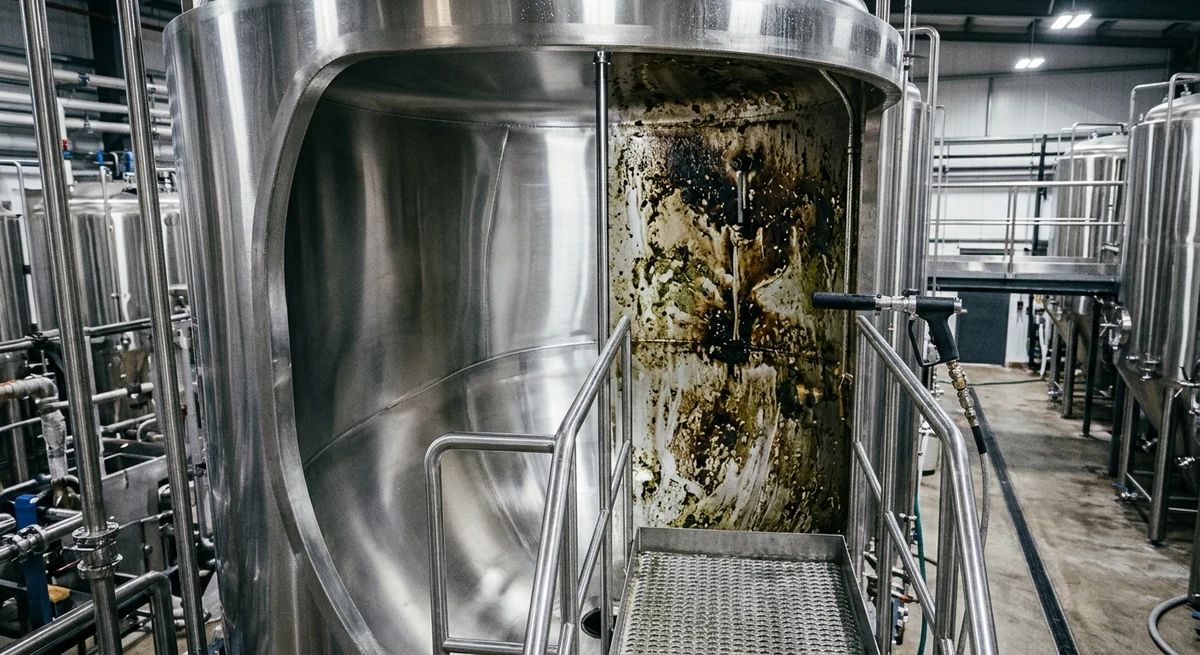
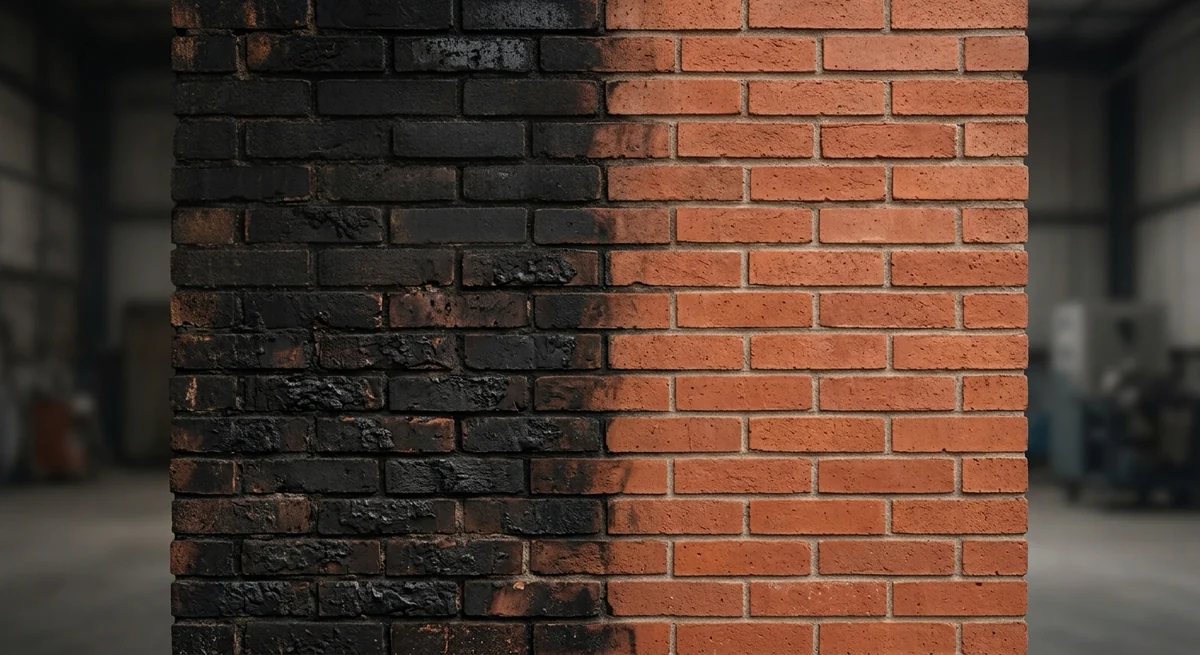
Two further points matter technically. Soot is acidic: fires involving PVC produce hydrogen chloride, which deposits chlorides onto steelwork and drives corrosion long after the fire is out. And char is porous. The blackened layer on timber or brick is not a stain sitting on top of the material, it is a sponge holding the pyrolysis products that carry the smell.
How dry ice blasting works on fire residue
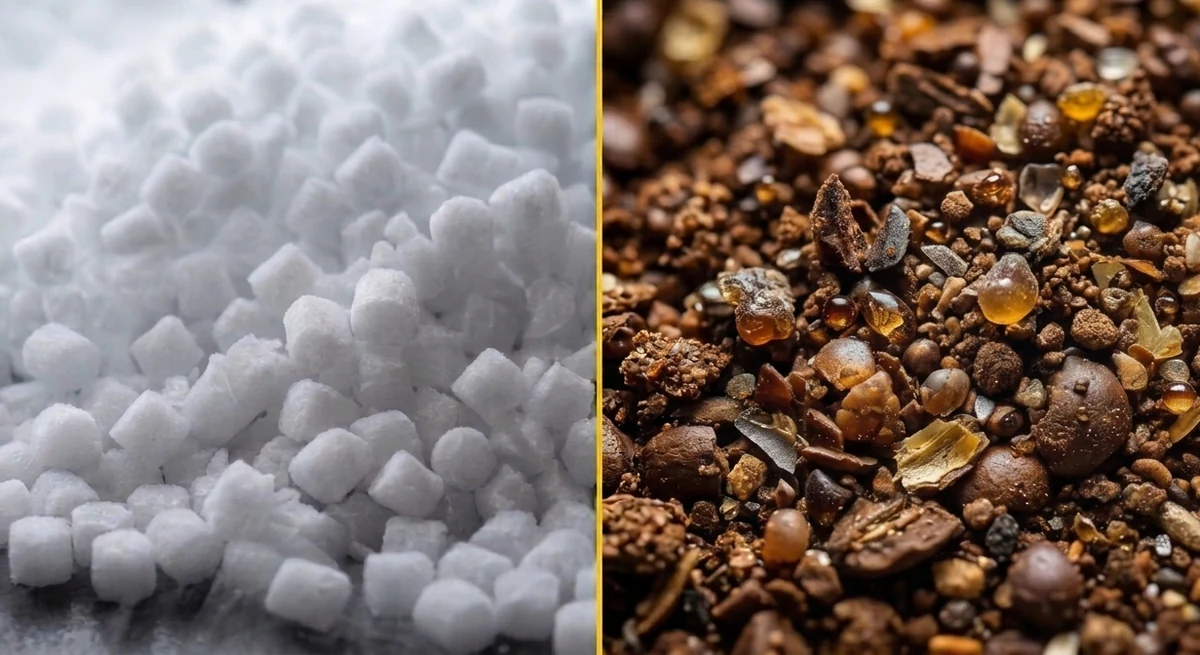
Solid CO2 pellets at −78.5 °C are accelerated in a compressed air stream. Three things happen on impact, effectively at once.
- Kinetic energy. The pellet strikes the deposit. On its own this is modest — dry ice is soft, around 2 on the Mohs scale, so it does not cut the substrate the way grit does.
- Thermal shock. The cold front hits the residue layer far faster than the substrate beneath. The two contract at different rates, the bond between them fails in shear, and the deposit embrittles and releases.
- Sublimation. The pellet turns straight to gas and expands roughly 700 times in volume, at the interface, under the loosened layer. That micro-expansion lifts the residue away from the surface rather than grinding it off.
Two consequences follow, and both matter on a fire job. The process is non-abrasive, so sound timber, brick, mortar joints, wiring and steel survive treatment that would be destroyed by grit. And the media disappears: the CO2 becomes gas, so the only waste to collect is the soot itself. On a fire loss where you are already managing contaminated debris, not adding spent abrasive to the pile is a genuine saving.
Odour: why source removal beats masking
Fire odour is not a smell in the air. It is volatile and semi-volatile organic compounds held inside the char layer and the pores of the substrate, released slowly over months. Warm weather and humidity drive them back out, which is why a property that seemed fine in March can be unbearable in July.
This is the core of the argument for blasting. Fogging, sealing and ozone all act on odour that has already been released. If the char layer is still on the timber, it keeps generating more. Removing that layer removes the reservoir.
Dry ice is well suited to it because the expanding gas works into surface porosity rather than skating over the top. On sawn timber, joists and rafters, brickwork and blockwork, it takes the soot out of the grain and the mortar joints in a way that wiping cannot — wiping wet smoke tends to smear it deeper into the pores.
A sequencing point worth holding to: never seal or fog before the source has been removed. Sealing traps a live odour source under a film that will fail, and it takes the option of proper cleaning off the table because you now have to remove the sealer first.
Staining: what lifts, and what stays
Deposited soot lifts. Staining that has chemically penetrated the substrate often does not, and it is worth being straight with clients about the difference before work starts.
- Usually recoverable: soot and smoke deposit on brick, block, concrete, sawn timber, steel and painted surfaces in sound condition
- Partially recoverable: tar and resin deposits, heavy staining on open-grain hardwoods, discoloration on porous natural stone
- Often not recoverable by blasting alone: scorching and heat discoloration in the material itself, tannin bleed in timber after water exposure, deep staining in unsealed limestone or soft lime mortar
Char is also not the same as staining. Where timber has lost section to charring — softwood chars at roughly 0.65 mm per minute of fire exposure — blasting reveals the damage, it does not repair it. Exposed charred timber still needs structural assessment of the residual section.
Where dry ice blasting stops
Being clear about limitations is what makes the method credible. The honest list:
- Line of sight only. The nozzle has to see the surface. Cavities, voids, boxed-in services and the backs of fixings are not treated.
- No drying capability. Firefighting water is a separate problem requiring extraction, dehumidification and moisture mapping.
- No biocidal action. Cold is not a disinfectant. Mould growing on a wet fire loss needs its own treatment.
- Substrate limits. Friable lime mortar, decayed timber, thin plaster and delicate finishes can be damaged. Test patches decide it, not assumptions.
- Noise. Typically 100–120 dB(A). Hearing protection is mandatory and it rules out work in occupied premises.
- CO2 accumulation. CO2 is heavier than air and pools in basements, pits and voids. The UK workplace exposure limit is 5,000 ppm over 8 hours and 15,000 ppm short term. Confined and low-lying spaces need atmospheric monitoring and forced-air extraction, not goodwill.
- Airborne soot. The process makes the contamination airborne by design. Containment and HEPA-filtered negative air are part of the job, not an optional extra.
- Chlorides remain. Blasting removes the deposit; it does not neutralise chloride contamination on steel, which needs testing and its own treatment.
What runs alongside it
A full fire restoration is a sequence. Dry ice blasting is one step in it, usually in the middle.
- Make safe and assess. Structural condition, charring depth, contamination survey, chloride testing on exposed steel.
- Water damage first. Extraction, drying and moisture monitoring to a documented target before enclosing anything.
- Soft strip. Unsalvageable porous materials come out — insulation, plasterboard, carpet, soft furnishings. No cleaning method recovers saturated mineral wool, and leaving it guarantees the smell returns.
- HEPA vacuum. Remove loose dry residue before blasting so you are not driving it around the building.
- Dry ice blasting. Structural timber, masonry, steelwork, plant and services.
- Chemical cleaning where it suits better. Alkaline degreasers on non-porous surfaces, particularly for protein and wet smoke films where a detergent outperforms blasting.
- Duct and plant cleaning. HVAC carries odour back into a cleaned space. It is a common reason jobs get revisited.
- Residual odour treatment. Hydroxyl or ozone in unoccupied spaces, thermal fogging where appropriate — only now that the source is gone.
- Sealing and reinstatement. Shellac-based stain-blocking primers where staining or odour persists in timber, then reinstatement of finishes and any fire-rated or intumescent coatings disturbed by the works.
Alternative blast media have their place in that sequence too. Sodium bicarbonate is water-soluble and mildly alkaline, which helps on greasy protein residues, though it leaves a residue needing washdown and is not suitable around live electrics. Dustless wet abrasive blasting handles heavy char on robust masonry and structural steel where dry ice would be uneconomic.
How we scope a fire job
Every fire loss is different, so we survey before quoting. That means identifying residue type, testing substrates with patches, checking access and ventilation constraints, and agreeing what is realistically recoverable against what should be stripped and replaced. You get a method statement covering containment, extraction and atmospheric monitoring before anyone starts.
We work as a specialist subcontractor to restoration companies and loss adjusters as well as directly for building owners. If you have a fire loss and want a straight answer on what blasting will and will not recover, send photos of the affected areas and we will tell you. Free site visits across Bedfordshire, Cambridgeshire and Hertfordshire.
Restore and protect your surfaces
Send us a few photos and we'll come back with a clear, fixed quote. Free site visits across Bedfordshire, Cambridgeshire and Hertfordshire.