Home / Blog / Method Selection
Dry Ice Blasting vs Traditional Blasting: What’s Best for Your Project?
Cost, speed, mess, safety and downtime compared across dry ice, dry abrasive and dustless wet blasting — with the jobs where dry ice is the wrong choice.
Ask which blasting method is best and the honest answer is that the question is the wrong way round. None of them is better in the abstract. What matters is the substrate you are cleaning, what is on it, what you intend to do next, and what the site will tolerate while the work happens. Get those four right and the method chooses itself.
This is a comparison of dry ice blasting against traditional dry abrasive blasting, with dustless wet abrasive included because it sits between the two and is often the right compromise.
What actually differs
All three accelerate a medium at a surface. The difference is what the medium does on arrival and what it leaves behind.
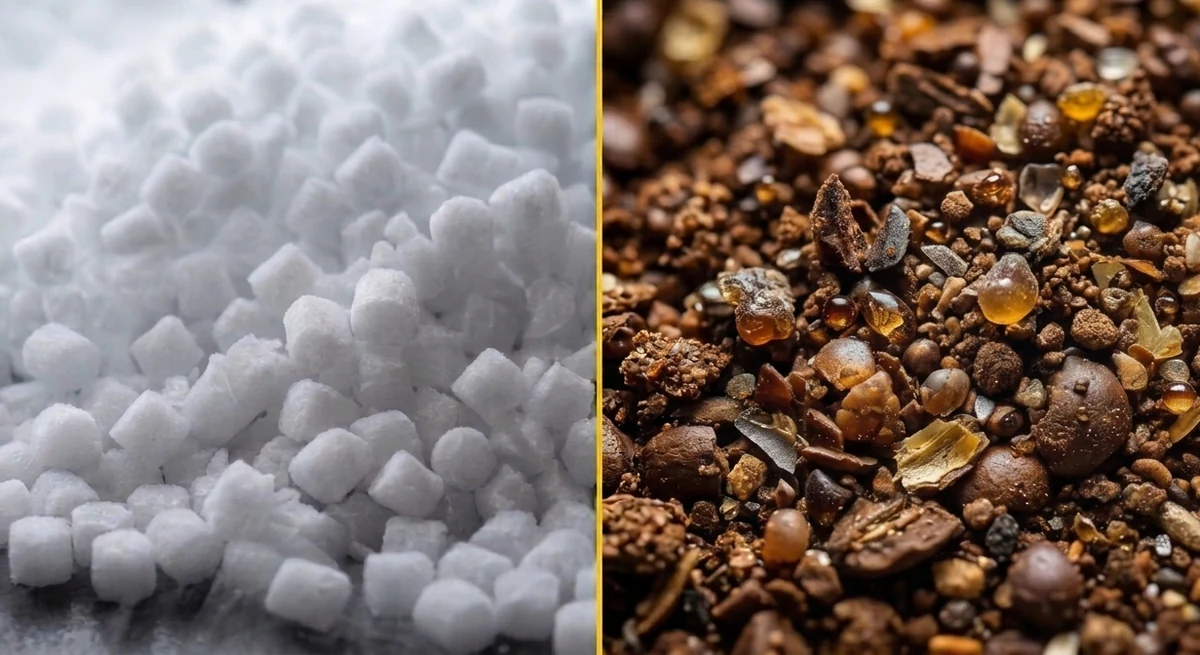
- Dry ice uses solid CO2 at −78.5 °C. It works by thermal shock and sublimation rather than abrasion, and the medium turns to gas on impact. It removes what is on the surface without touching the surface itself.
- Dry abrasive uses garnet, chilled iron, slag or similar at pressure. It cuts. It removes contamination and a controlled amount of the substrate with it, which is exactly what you want when you need to get back to sound metal.
- Dustless wet abrasive encapsulates the same abrasives in water. It still cuts, but the water suppresses dust and reduces heat build-up on thin panels.
One clarification worth making, since the phrase persists: almost nobody in the UK is sandblasting. Silica sand for open abrasive blasting has been restricted here for decades because of the silicosis risk, and what people call sandblasting is now garnet, slag or iron. If a contractor genuinely offers silica sand, that is a reason to ask questions.
Side by side
| Factor | Dry ice | Dry abrasive | Dustless wet |
|---|---|---|---|
| Cost per m² | Highest media cost, but often lowest total cost once masking, containment and cleanup are counted | Lowest media cost; disposal and reinstatement add up | Middle on both counts |
| Speed | Slower on heavy coatings, fast on soot, grease, adhesive and mould | Fastest on mill scale, heavy rust and thick multi-coat systems | Close to dry abrasive, usually a little slower |
| Mess and waste | Contaminant only — the medium becomes gas | Spent abrasive plus contaminant, several times the waste volume | Slurry to contain, settle and dispose of |
| Safety concerns | CO2 pooling in low spaces, 100–120 dB(A) noise, cold burns, airborne contaminant | Respirable dust, rebound, noise, HAVS, confined-space risk | Much lower dust, but water, slip and slurry handling |
| Downtime | Lowest — often in situ with plant in place, no drying time | Highest — strip out, mask, contain, clean down afterwards | Moderate — add drying time and flash-rust control on steel |
| Effect on substrate | Non-abrasive, leaves the surface as found | Removes substrate, creates an anchor profile | Removes substrate, creates a profile |
| Anchor profile for coating | No | Yes, to ISO 8503 | Yes |
The cost row is the one that misleads people most often. Dry ice media is genuinely expensive per kilo. It still frequently wins on total cost, because the expensive parts of an abrasive job are rarely the abrasive — they are the masking, the containment, the lost production time and the man-hours spent clearing spent grit out of a building afterwards.
Where dry ice earns its place
The pattern across the work we do is consistent: dry ice wins when the substrate must survive intact, or when the surrounding environment cannot tolerate grit.
Plant that cannot be dismantled
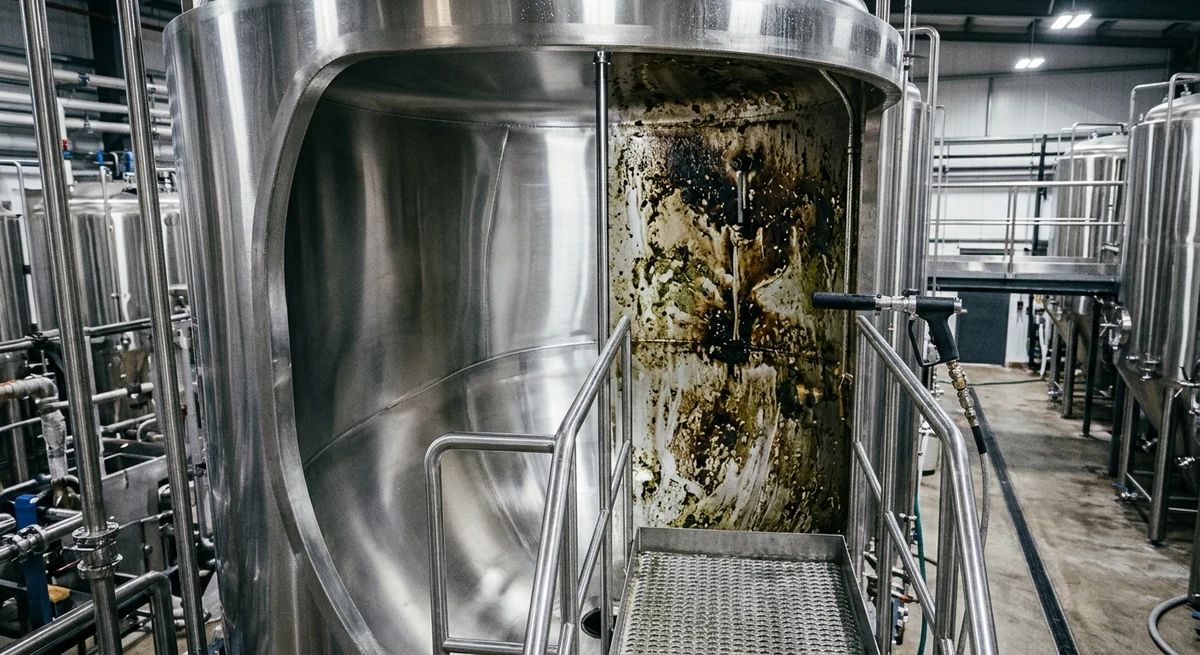
An industrial mixer caked in hardened product is a good example. Grit would clean it, but it would also pit the vessel, find its way into bearings and seals, and require the machine to be stripped and the area sealed off. Dry ice cleans it in place, and because the medium disappears there is nothing left in the plant afterwards. The saving is measured in production hours, not in media.
Rotating and precision assemblies
Turbine rotors are the clearest case. The blade profiles are the component. An abrasive that removes even a small amount of parent material changes the geometry and the balance, so it is simply not an option. Dry ice lifts deposits off the blades and leaves the profile untouched.
Fire and smoke damage
Soot on structural timber and masonry is where dry ice is hardest to beat. It lifts the char out of the grain and the mortar joints, removing the material that carries the smell, without eroding the timber. Grit on sound structural softwood would destroy the surface to remove a contaminant that sits in the top fraction of a millimetre.
Timber, heritage and mixed-material spaces
Loft timbers, exposed beams and heritage brickwork all share a problem: the contamination is superficial and the substrate is soft. Blasting them with grit trades one problem for a worse one.
Live or sensitive environments
Food production areas, working facilities and buildings full of services favour a method that leaves no residue to find its way into a product line or a bearing housing.
Where traditional blasting is the right answer
Being honest about this matters more than promoting one method. Dry ice is the wrong tool for a large share of surface preparation work.
Anything being recoated
This is the big one. Protective coatings need a mechanical key. Specifications call for a cleanliness standard and a surface profile, typically Sa 2½ with a profile to ISO 8503, and dry ice produces neither. It will clean steel beautifully and leave it just as smooth as it found it. If the next operation is a coating with a warranty attached, the preparation is abrasive.
Corrosion and mill scale
Dry ice does not remove rust or mill scale to any useful degree, and it will not strip sound multi-layer coatings economically. Structural steel, marine hulls and heavily corroded plant are abrasive work.
Large open areas of robust substrate
Where the substrate is tough, access is good and cleanup is straightforward, grit is faster and cheaper per square metre. A steel-framed building with good containment does not need dry ice pricing.
Where wet blasting beats both
Heavy char on masonry, marine antifoul, and thin panels prone to heat distortion all favour dustless wet blasting. We wrote about that comparison in more detail in dustless wet blasting versus traditional sandblasting.
When dry ice blasting is not the right choice
Pulling the limitations into one list, because it is the question worth asking before you commission anything:
- You need a profile for coating. Dry ice cleans, it does not key. Covered above, and it is the most common reason to say no.
- The target is rust, mill scale or a sound thick coating. Wrong mechanism, uneconomic in practice.
- The space is confined or below ground. CO2 is heavier than air and pools. Without monitoring and forced extraction this is a hazard, not an inconvenience.
- The premises are occupied. At 100–120 dB(A) the work needs the area cleared.
- The substrate is friable. Perished lime mortar, decayed timber and thin plaster can be damaged. Test patches decide, not assumptions.
- The contaminant is water-soluble or greasy. If a detergent and a pressure washer will do it, they are cheaper.
- There is water damage or mould. Dry ice neither dries nor disinfects. Those are separate operations.
- Budget is the binding constraint and the substrate is tough. If grit will not harm it and cleanup is easy, grit is the commercial answer.
How we decide
On survey we work through five questions, in this order:
- What is the substrate, and what condition is it in?
- What is being removed, and how thick and how well bonded is it?
- What happens to the surface next — is it being coated, and to what specification?
- What will the site tolerate: noise, dust, water, access, occupancy, ventilation?
- What does downtime actually cost, compared with the price of the cleaning?
That last one changes the answer more often than anything else. A method that costs more per square metre but keeps a line running is usually the cheaper job.
Because we run dry ice, dustless wet and conventional abrasive blasting alongside coating application, we have no reason to push one at you. Send photos and tell us what the surface is for afterwards, and we will tell you which method fits and why. Free site visits across Bedfordshire, Cambridgeshire and Hertfordshire.
Restore and protect your surfaces
Send us a few photos and we'll come back with a clear, fixed quote. Free site visits across Bedfordshire, Cambridgeshire and Hertfordshire.