Tank and Vessel Cleaning for Food and Beverage Manufacturers
Dry ice blasting for food and drink plant — why it suits hygiene-critical cleaning, where it beats a strip-down, and the confined-space limits on blasting inside a tank.
Why food and beverage plant is a different problem
Cleaning a mixing vessel in a food or drink factory is not the same job as cleaning one in a foundry. Three things change the brief.
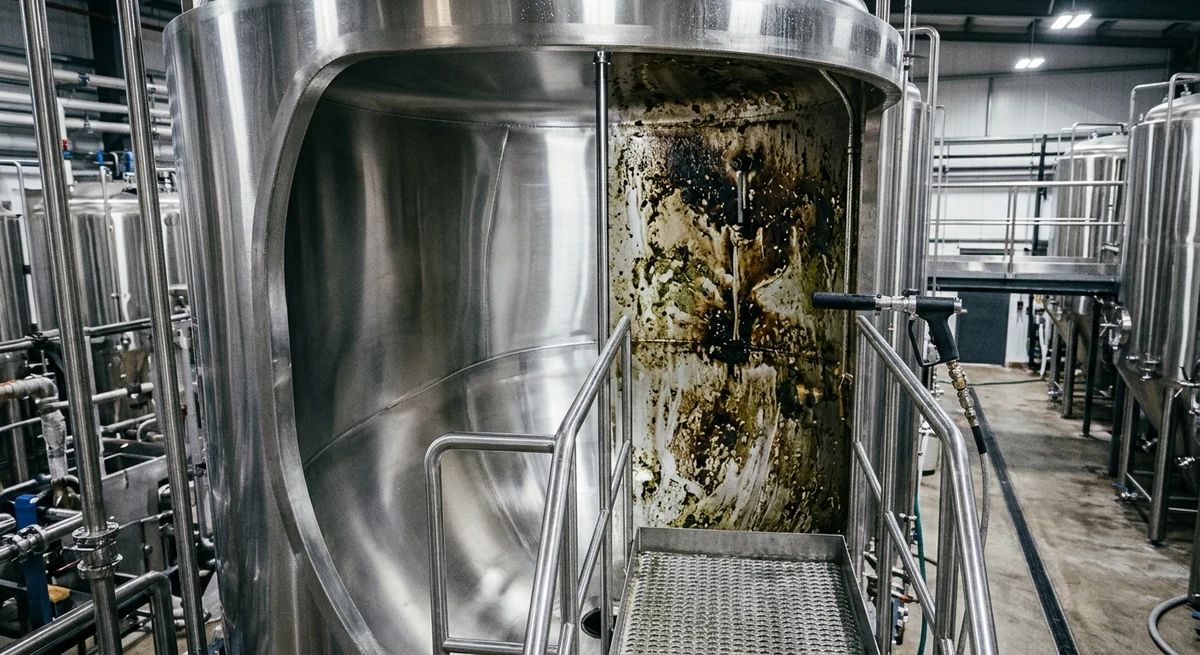
- The residue is biological. Sugars carbonise onto heated surfaces, proteins denature and bake on, fats polymerise into varnish, and anywhere moisture lingers you can get biofilm — a bonded microbial layer that ordinary washing does not reliably shift.
- You are audited. BRCGS, SALSA and customer audits all want documented, repeatable cleaning with no risk of introducing a contaminant. A cleaning method that leaves grit, media or chemical residue behind creates a new hazard to control.
- Downtime is the real cost. On a line turning over thousands of units a shift, the cleaning bill is rounding error next to the hours the line is down. A method that halves the strip-down usually wins even if it costs more per hour.
Add allergen changeover to that and the stakes rise again. If a line runs a milk or nut recipe and then switches, the validation burden on the clean is considerable — and anything that reaches into corners a cloth cannot is worth having.
Why dry ice suits food plants
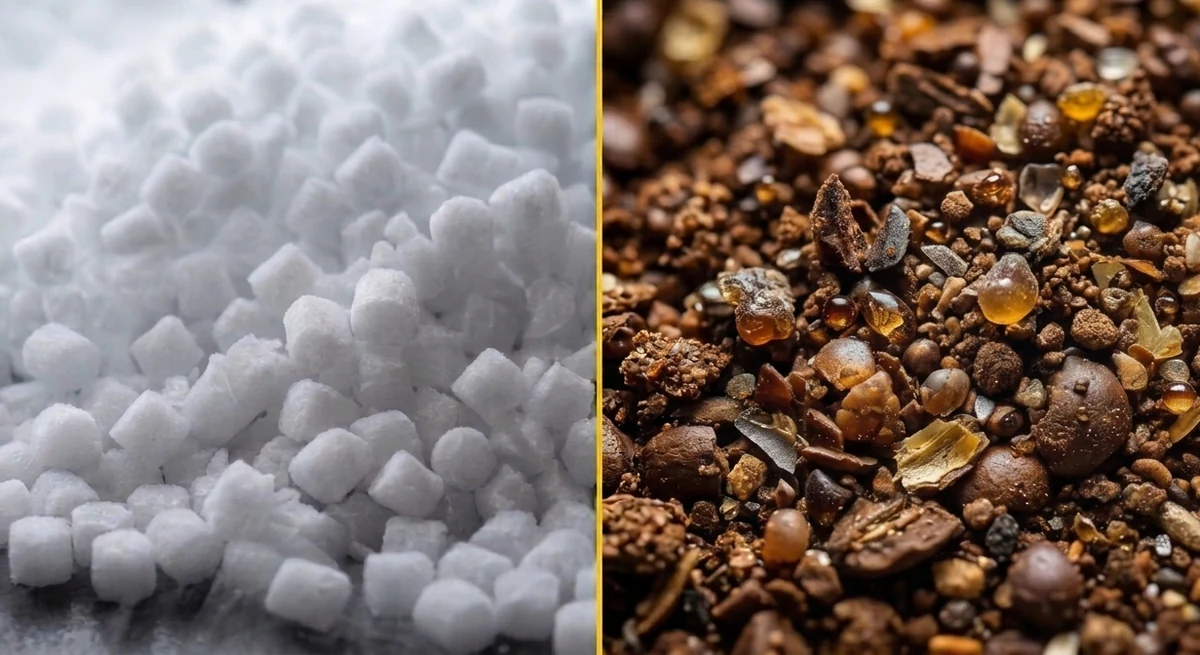
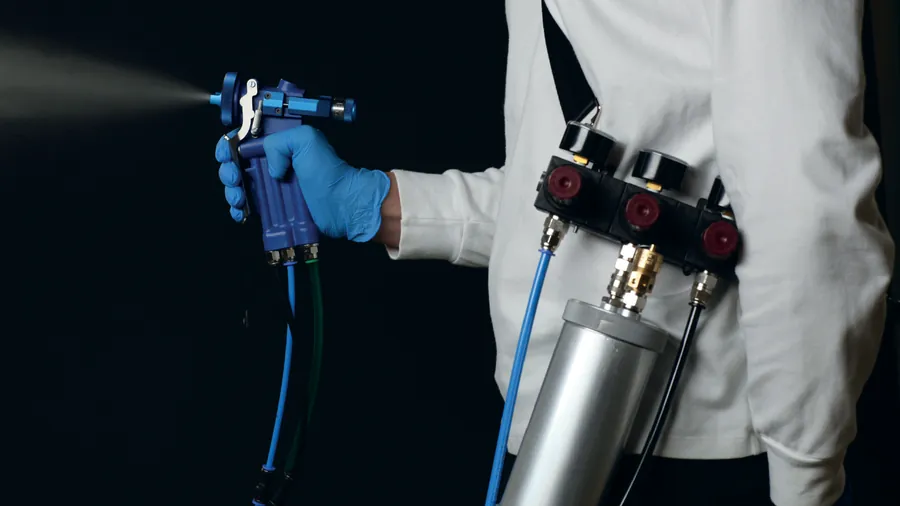
Solid CO2 pellets at −78.5 °C are fired at the surface. They embrittle the deposit by thermal shock, break the bond between deposit and substrate, and then sublimate — turning straight to gas and expanding roughly 700 times at the interface, lifting the residue clear. Four consequences matter here.
- No water. Water is what turns a cleaning operation into a Listeria risk. Dry ice introduces none, which is why it suits low-moisture production in particular.
- No chemicals. Nothing to rinse, nothing to validate the removal of, no COSHH burden from the cleaning agent itself.
- No secondary waste. The medium becomes gas. The only thing to collect is the soil that came off, which keeps the waste stream simple and the audit trail short.
- Often no strip-down. Much plant can be cleaned in place, sometimes still warm, without dismantling guards, agitators and seals — which is where the downtime saving actually comes from.
There is published support for the hygiene case. The UK Food Standards Agency documented the process as early as 2004, finding that Salmonella enteritidis, E. coli and Listeria monocytogenes were not detectable on treated surfaces using conventional microbiological methods. Dry ice is also an accepted blasting medium for the FDA, USDA and EPA in the United States.
Worth being precise about one thing: dry ice blasting is a cleaning process, not a sanitising one. It removes the soil that harbours organisms and it has been shown to reduce them to below detection, but it is not a substitute for your sanitiser step. Treat it as the deep clean that happens before the disinfection, not instead of it.

The part most people skip: a tank is a confined space
This is where we would rather lose the enquiry than win it badly, so we will be blunt about it.
CO2 is denser than air. It sinks, and it pools. The HSE is explicit that it collects in tanks, sumps and cellars, displaces oxygen and has caused asphyxiation deaths. The GB workplace exposure limits are 5,000 ppm over an 8-hour period and 15,000 ppm over 15 minutes. It is colourless and odourless, so nobody in the vessel will notice the level climbing — the first symptoms are headache, dizziness and confusion, which are also the first things to stop someone saving themselves.
Now put that together with what a dry ice blaster does: it continuously generates CO2 gas, at volume, at the lowest point of an enclosed steel vessel with one opening at the top.
Storage tanks, silos, reaction vessels and vats are named examples of confined spaces under the Confined Spaces Regulations 1997. The duties run in a strict order, and the order matters:
- Avoid entry if you can. Do the work from outside, or change the method so nobody has to go in.
- If entry is unavoidable, work to a safe system. Planned, trained, supervised, with precautions set by a specific risk assessment.
- Have emergency arrangements in place before anyone enters. Communications, rescue equipment and trained rescuers — ready, not improvised.
In practice, blasting inside a closed vessel is only defensible with forced low-level extraction, because exhaust has to be drawn from the bottom where the CO2 actually sits, together with continuous atmospheric monitoring for both CO2 and oxygen, a permit to work, and a rescue plan that does not rely on the person inside.
Any contractor who offers to blast out the inside of your tanks without raising any of this is telling you something important about how they work.
Where dry ice earns its place, and where it does not
Being straight about the boundary is what makes the method useful rather than oversold.
| Application | Verdict | Why |
|---|---|---|
| Vessel and tank exteriors, jacketing, supports | Strong fit | Open air, no strip-down, no water near electrics or lagging |
| Agitators, shafts, paddles, mixer heads | Strong fit | Complex geometry, baked-on product, non-abrasive to the finish |
| Conveyors, fillers, formers, packing plant | Strong fit | Clean in place, often warm, without dismantling |
| Ovens, dryers, hoppers, chutes | Strong fit | Carbonised sugar and protein come off without abrasion |
| Open-topped vats with good ventilation | Case by case | Depends on extraction, access and monitoring |
| Closed tank interiors | Only with engineered extraction | Confined space plus a CO2-generating process — the hazard combination that kills people |
| Product-contact surfaces needing sanitising | Not on its own | Cleaning step, not a disinfection step |
| Routine wash-down of simple wetted surfaces | Wrong tool | Existing clean-in-place circulation is cheaper and faster |
That last row is worth dwelling on. If your vessels already have a working clean-in-place system circulating caustic and acid through fixed spray balls, dry ice is not there to replace it. CIP handles the wetted interior. Dry ice handles everything CIP cannot reach: the outside of the vessel, the drive end, the framework, the plant around it, and the equipment that cannot take water or cannot be dismantled.
What a job actually looks like
For a food or drink site we would expect to work through roughly this sequence:
- Survey and test patch. Identify the soil, confirm the substrate tolerates the process, agree what is in and out of scope.
- Method statement and risk assessment, covering containment, extraction, atmospheric monitoring, noise and any confined space element, issued before anyone arrives.
- Isolation and protection. Lock-off, and masking of anything that must stay clean or dry.
- Containment and extraction sized for the space, with exhaust taken at low level.
- Blast, working to the agreed sequence so cleaned areas are not re-soiled.
- Debris collection and handover, with the area left ready for your sanitiser step and sign-off.
Two practical notes. The process runs at roughly 100–120 dB(A) at the nozzle, so the area needs clearing and hearing protection is mandatory — it is shutdown or out-of-hours work, not something to run alongside a live line in the same room. And we hold upper-tier waste carrier registration (CBDU537838), which matters when the debris coming off your plant has to leave site properly documented.
In short
For food and beverage manufacturers, dry ice blasting solves a specific problem well: it removes bonded product residue from complex plant without water, without chemicals, without abrasion and usually without a strip-down, which is where the downtime saving lives. It does not replace your CIP system, it does not sanitise, and inside a closed tank it introduces a genuine confined-space hazard that has to be engineered out before anyone goes near it.
If you have a vessel, a mixer or a line that is difficult to clean, tell us what is on it, what the substrate is and what your shutdown window looks like, and we will tell you honestly whether this is the right method. Free site visits across Bedfordshire, Cambridgeshire and Hertfordshire, and we travel for shutdown work.
Restore and protect your surfaces
Send us a few photos and we'll come back with a clear, fixed quote. Free site visits across Bedfordshire, Cambridgeshire and Hertfordshire.